
Link to Today's Hangout is HERE
NOTES ON GAUSS: Please make sure that you have an appropriate working model for evaluating WHEN you can apply Gauss and when you can't. For example, think of the 'basic' equation as kind of a check list:
∮Ecosθ dA
- Is "E" Constant?
- Is the area vector constant?
- Is θ = 0?
════════════════════
SNOW DAYS:
Please find a partner to correspond with and meet in person with if posssible. I have no idea what the coffee shop situation is because I'm snowed in! But if you can, please meet in person.
I have the next few days posted but I'll be making changes and adding my answers to assigned problems.
Please keep in mind there will be a VERY strong urge to just let this work slide, that would be *most* unwise. I'm going to proceed as if everyone is keeping up. It's snowing pretty hard now (12:45 on Feb 11th) and they are saying there may be sleet, freezing rain and other such things to look forward to. Those conditions CAN lead to frequent power outages so we may have to roll with those....
Please check in with your partner, and let's plan on 'meeting' online at 1:00 every day that we're out (except Friday, I have chores, if I can tend to them) on hangouts.
════════════════════
OPENING QUESTIONS: Consider a spherical Gaussian surface with radius r surround a charged object. Explain why the net flux DOES NOT increase if we double that radius.
OBJECTIVE: I will be able to describe the difference between electric potential and electric potential energy after today's class.
WORDS/FORMULAE FOR TODAY
Terms:
- Test Charge: A mathematical construct-- a charge that does not exert any influence on surrounding particles but IS influenced by other electric fields.
- conductor - materials where electrons can roam
- insulator - materials that keep their electrons close to home
- coulomb - a unit of electrical charge (see below)
Constants:
- e-mass = 9.1 x 10⁻³¹ kg
- charge of an electron = 1.60 x 10⁻¹⁹ coulombs (C)
- ke = 8.987 x 10⁹ Nm2/C2
- ke = 1/4πεo
Formulae:
- Electric Potential (V) and Electric Potential Energy (UE)
- Electrical Force: Fe = (keq1q2)/r2
- Electrical Field:
- E = Fe / qo where qo = a positive test charge
- E= (keq)/r2
- Gauss's Law:
Φ = ∮E ∙ dA or ∮Ecosθ dAwhere θ is the angle between the electrical field line vector and the area vector = Φ = qin/εo : the electric flux through an ENTIRE gaussian surface is equal to the algebraic sum of the charges INSIDE the surface divided by the permitivity of free space
Generally: the more symmetric the surface area of the gaussian surface the more accurate is this formula
∆U = -q∫E ∙ ds
Vb - Va = ∆V = ∆U/q = -∫E ∙ ds
W = q∆V = -UE
V = ke∑qi/ri (between some point in space and each charged particle present in that region of space)
UE = ke∑q1q2/ri (between each particle in space and every other particle in that region of space)
WORK O' THE DAY:
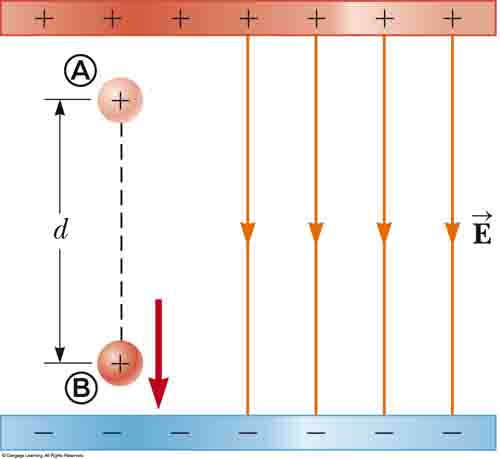
Consider the case of a test charge placed in an electric field between two charged plates (1 plate is positive, the other is charged negative).
1) Predict the motion of that test charge.
2) Does the orientation of those charged plates make any difference as to the motion of that test charge?
3) Predict how the electric potential energy of the test charge changes as the test charge moves.
4) Why does that indicate that the electrical force is a conservative field?
Voltage is a measure of the POTENTIAL that an electric charge has inside an electric field. Sometimes it is helpful to view electric potential similar to the way we look at gravitational potential:

Much in the same way that we describe the potential for movement in a gravitational field, we can describe the potential for movement in an electrical field.
In E & M we have a specific term for electrical potential: Voltage (NOTICE that is NOT potential energy, it is simply called the electric potential)
Consider the case of a charged particle present in an electrical field. That charged particle will be influenced to move based on the presence and direction of the electric force indicated by the electrical field.
The degree to which that particle "wants" to move is a quantifiable value that we call 'voltage'. In most basic terms, that 'electric' potential (V) can be described by the electrical potential energy UE divided by the size of the charge of that particle q:
V = UE/q (or joules per coulomb)
Such a particle present in an electrical field will undergo a change in electrical potential energy by moving from an area of higher potential to lower potential as described by:'
∆UE = -q∫ab E ∙ ds
where the integral is evaluated by the initial (a) position of the particle and the final position (b) of that particle and (s) represents an infinitesimal point-to-point distance the particle traveled.
Recall that the electrical field is a conservative field, so that path in which the particle moves from point a to point b is irrelevant
∆V = ∆U/q = -∫ab E ∙ ds
keep in mind that we often deal with UNIFORM (eg 'constant') electric fields... in such cases:
-∫ab E ∙ ds → -E∫ab ds → -Ed
since we are integrating over some path from b → a (remember, the path is unimportant since the E field is conservative) the distance that particle moves is discreet (will call it 'd')
Therefore the work done in moving a particle is given by:
W=q∆V
════════════════════
Example 25.2 Using Forces

HOMEWORK: 25.2, 7 & 11
#2) Here's an interesting question for you... why did the author choose the key/weasel word "uniform" to describe the Efield here?
